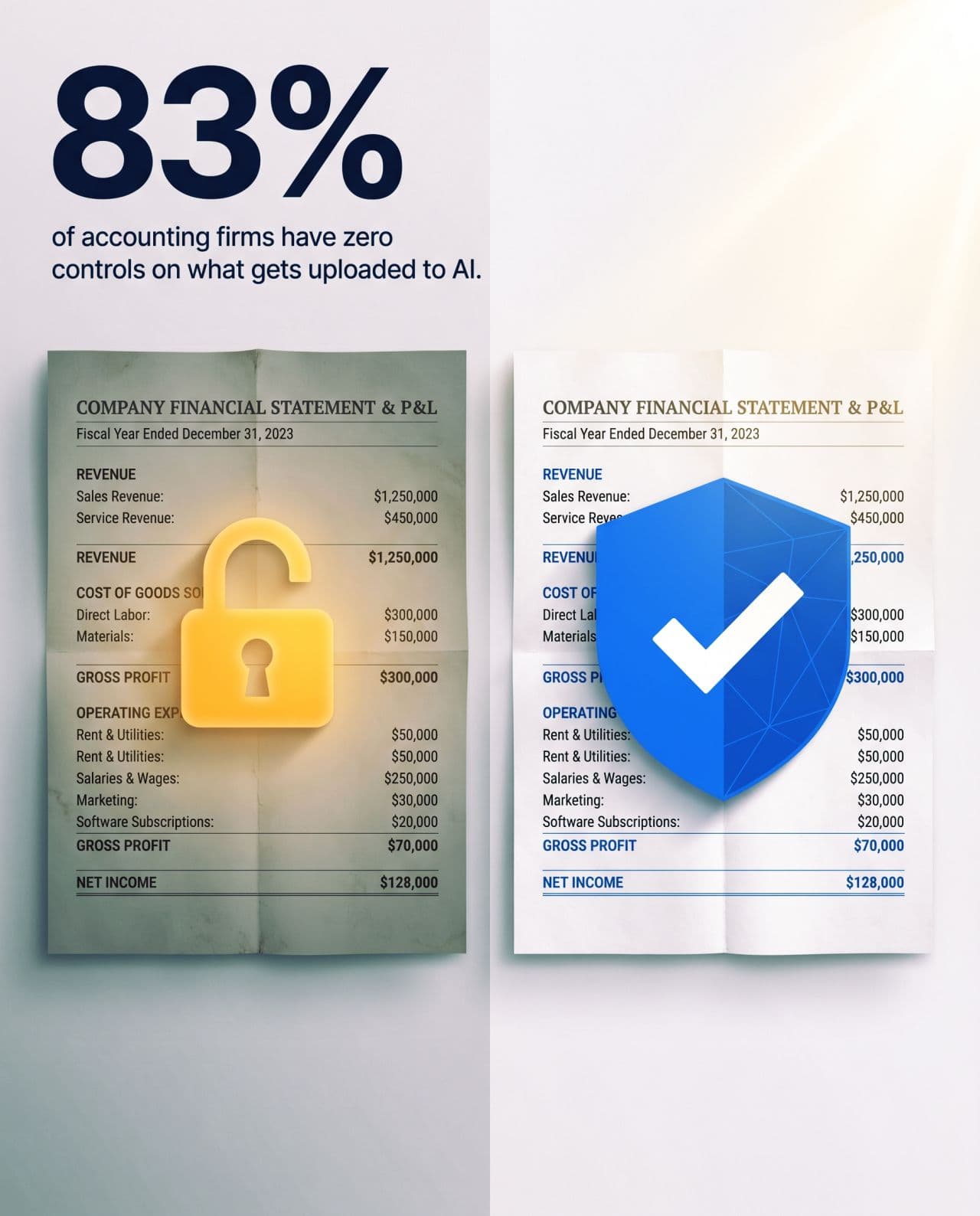
Every time you paste a client's financial statement into ChatGPT, that document leaves your control. This isn't a scare tactic—it's an operational reality that most accounting firms have not come to terms with.
83% of accounting firms have no technical controls preventing their team from uploading confidential client data to public AI tools. There is no policy enforcement, no blocked domains, no monitoring—just an open door between sensitive client files and whatever AI tool an employee happens to have open in another tab.
For bookkeepers, that absence of controls isn't simply a cybersecurity gap. It's a fiduciary one. The data in question—P&L statements, payroll records, bank statements, tax filings—belongs to the client, and the firm has a professional duty to safeguard it. Once that data is pasted into a public chatbot, the firm has effectively lost the ability to guarantee where it goes, how long it's kept, or who else might eventually see it.
The Use Case Is Legitimate—The Tool Is the Problem
Here's the irony: the underlying reason bookkeepers reach for these tools in the first place is entirely legitimate. Clients ask questions that used to take twenty minutes of manual searching through statements and ledgers to answer. AI can answer the same questions in seconds, and that productivity gain is real and valuable to the practice.
The mistake isn't the workflow—it's the tool. There is a meaningful difference between pasting a client's P&L into a public chatbot, and running AI across your actual client documents inside a secure, encrypted environment built for exactly that purpose.
What AI for Bookkeeping Should Look Like in 2026
Consider a question like, “What were all expenses over $5K in Q2 for this client?” In a secure environment, that question gets answered in roughly eight seconds—pulled directly from the client's actual files, with no copy-pasting and no manual line-by-line search. Crucially, the client's data never touches a public training dataset, never gets retained on a third-party server beyond the firm's control, and never becomes part of a model that other users might inadvertently surface answers from.
That combination—the speed and convenience of AI, paired with the confidentiality guarantees the accounting profession requires—is what AI for bookkeeping should look like going forward. Firms don't need to choose between productivity and professional responsibility; they need a tool that was built with both in mind from the start.
Join the Conversation
Are you currently using AI on client financials? How are you handling the confidentiality piece? Let us know in the comments—we'd like to hear how other firms are navigating this.