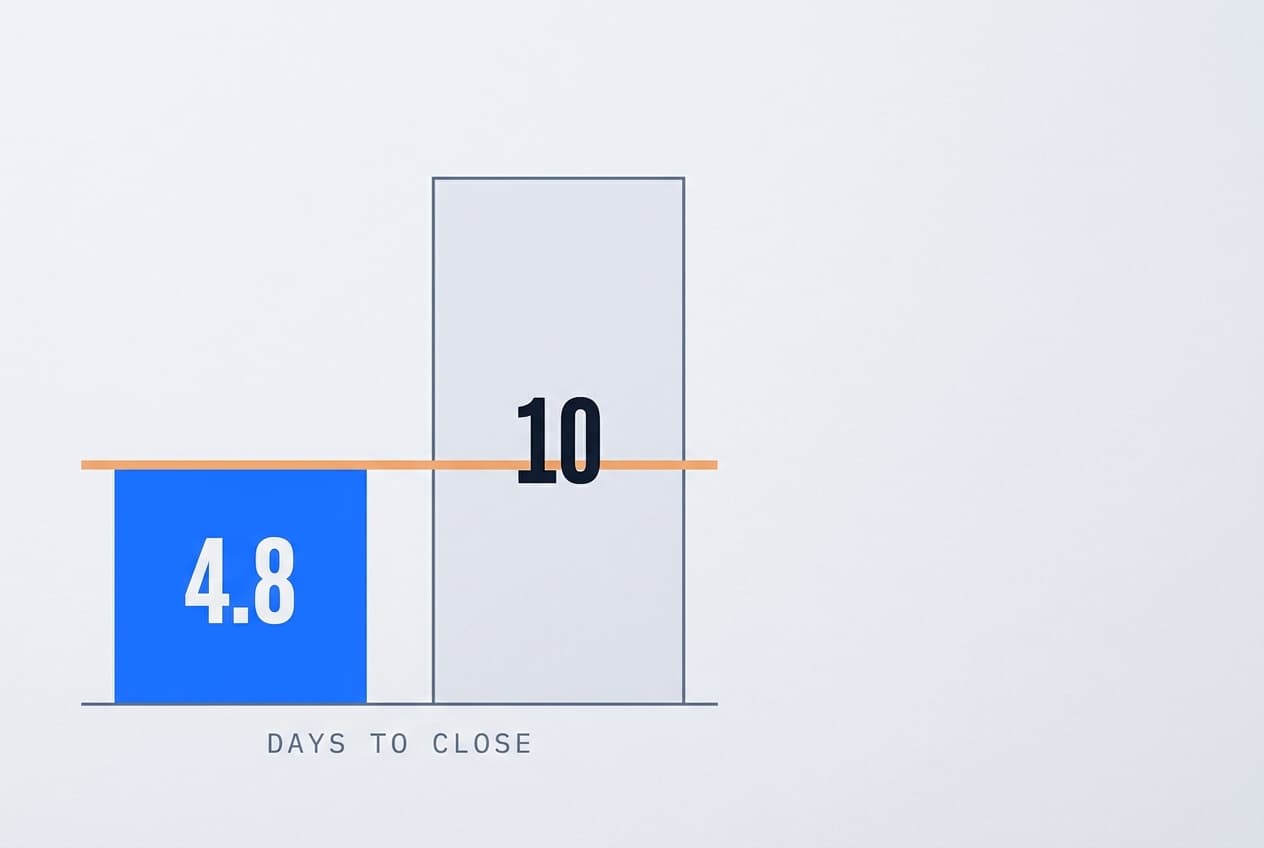
Two finance teams of the same size, in the same industry, close the same month. One is done in five days. The other takes ten. Ask either one whether they worked hard that week and you will get the same answer.
What the Benchmark Actually Measures
APQC asks a narrow question in its General Accounting Open Standards Benchmarking survey: the cycle time in calendar days between running the trial balance and completing the consolidated financial statements. Of the 2,300 organisations that answered, the median came in at 6.4 calendar days. The top quarter finish in 4.8 days or less. The bottom quarter take ten or more.
That is a spread of more than five days between the fast and the slow, on a task that is nominally the same task. Nobody in the bottom quartile is closing slowly on purpose.
The interesting question is what the fast teams have that the slow ones do not, because the answer is not headcount and it is not hours.
The Two Days Hiding in Your Chart of Accounts
APQC's finding is that organisations with strong data governance outperform the rest, and it puts a number on one specific practice: adopting a standardised chart of accounts can shave about two days off the close.
Two days. Not from working faster, not from adding a person, and not from buying a close-management tool. From the accounts being named and structured consistently enough that nobody has to stop and work out what a line means.
That is worth sitting with, because a standardised chart of accounts is not a technology project. It is a decision, made once, that removes a category of question from every subsequent month.
APQC identifies poor-quality data as the primary barrier to a faster close. Not process design, not software, not staffing. Data.
Why It Feels Like a Workload Problem
From inside the close, none of this looks like a data problem. It looks like a week of work.
Someone is reconciling an account that does not tie. Someone else is trying to establish which of two similarly named accounts an accrual belongs in, which means finding out what was decided the last time the question came up, which means finding the person who decided it or the file where they wrote it down.
Every one of those is a retrieval task wearing the costume of accounting work. The judgment involved takes seconds once the information is in front of you. The finding takes the afternoon.
This is why adding a person to a slow close helps less than it should. A new person does not know where anything is, and the only people who can tell them are the ones already at capacity. For the first few months, an extra pair of hands makes the close slower.
The Cost Is Not the Days
A ten-day close is not five days worse than a five-day close. It is five days worse, every month, forever, plus the compounding.
Numbers that arrive on day ten inform decisions differently from numbers that arrive on day five. By the time a slow-closing team can tell you what happened in March, April is nearly over and the useful window for acting on March has closed. The reporting becomes a record rather than a signal.
There is a second cost that is harder to see. The team that spends ten days closing has fewer days left for the work that is not closing: the variance nobody explained, the forecast that needs revisiting, the question the business asked in week two. Advisory work is what gets squeezed, because it is the only item on the list with no deadline attached.
Where the Documents Come In
The principle underneath APQC's finding is that a fast close is a well-governed one, and governance is mostly about being able to answer questions about your own information without an excavation.
MetaWurks exists for the part of that which is a document problem. It ingests the files a finance team already works from, including statements, invoices, contracts and scanned paperwork, and makes them answerable in plain English rather than through folder navigation. The question becomes what the payment terms on a particular vendor agreement are, not which drive that agreement is on. Retrieval runs across the whole set rather than one file at a time.
It does not standardise your chart of accounts, and it does not close your books. What it removes is the part of the close spent locating the thing that decides the entry. Role-based access and audit logs record who opened what, and because documents ingested into the platform are not used to train models or exposed to other users, financial records stay inside the team's control while that happens.
The close will still take judgment. It should. What it does not need to take is an afternoon of searching before the judgment can begin.
Join the Conversation
In your last close, how much of the time went to deciding things, and how much went to finding the information you needed before you could decide?