Why Custom-Trained Private LLMs Are Outperforming General-Purpose Models
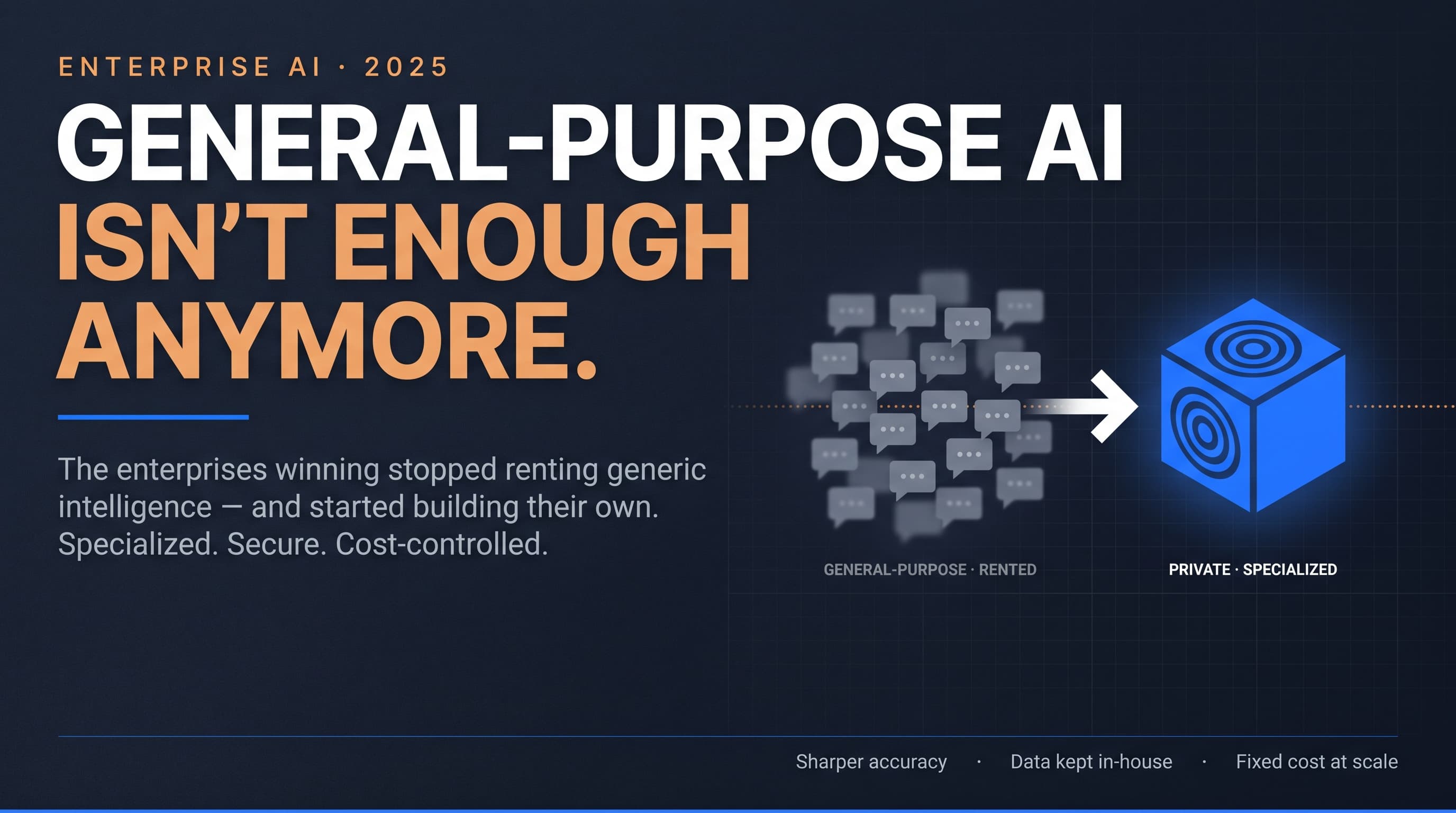
The artificial intelligence landscape is undergoing a fundamental shift. While general-purpose large language models (LLMs) like GPT-4 and LLaMA captured headlines with their broad capabilities, enterprises are increasingly discovering that one-size-fits-all solutions fall short when confronted with specialized business challenges. Custom-trained private LLMs—domain-specific models built on proprietary data and deployed within controlled infrastructure—are emerging as the superior alternative for organizations that prioritize accuracy, security, and operational efficiency. This transformation represents more than incremental improvement; it signals a strategic reorientation in how enterprises deploy AI at scale.
Domain-Specific Accuracy: Precision Where It Matters Most
General-purpose LLMs are trained on vast, heterogeneous datasets spanning the open internet, which inevitably dilutes their expertise in any single field. A model that must simultaneously understand poetry, pop culture, and particle physics cannot achieve the same depth as one immersed exclusively in a specific domain. Domain-specific LLMs address this limitation through targeted specialization techniques that dramatically enhance output quality.
Technical Approaches to Domain Specialization
Organizations can pursue multiple pathways to build domain expertise into their models, each offering distinct trade-offs between control, resource investment, and performance:
| Technique | Description | Resource Intensity | Best For |
|---|---|---|---|
| Prompt Engineering | Crafting specialized prompts to elicit domain-appropriate responses without model modification | Minimal | Rapid prototyping, low-volume use cases |
| Retrieval-Augmented Generation (RAG) | Connecting foundation models to external knowledge bases for real-time information retrieval | Moderate | Dynamic domains requiring current information |
| Fine-Tuning | Re-training pretrained models on curated domain datasets to adapt weights and embeddings | Moderate-High | Stable domains with established knowledge corpora |
| Training from Scratch | Building entirely new models on domain-specific data from the ground up | Very High | Maximum control, unique data assets |
| Hybrid Approaches | Combining multiple techniques (e.g., fine-tuning for style plus RAG for current data) | Variable | Complex enterprise requirements |
The accuracy gains from these approaches are substantial and measurable. Consider PubMedGPT, fine-tuned exclusively on biomedical literature from the National Institutes of Health's PubMed database. By training on scientific abstracts, research articles, and specialized medical terminology, this model achieves significantly higher performance on clinical decision support, research summarization, and medically relevant query answering than general-purpose alternatives. Similarly, BloombergGPT—a 50-billion parameter model built from scratch on 363 billion tokens of financial data—demonstrates how deep domain immersion enables nuanced understanding of market terminology, regulatory frameworks, and financial reasoning that general models cannot replicate.
The Linguistic Nuances That General Models Miss
Domain-specific accuracy extends beyond factual knowledge to encompass the subtle linguistic characteristics that define professional communication. Legal documents follow precise formatting conventions with specialized terminology like "hereinafter" and "witnesseth"; medical prescriptions require exact dosage specifications and interaction warnings; financial reports demand consistent compliance with regulatory disclosure standards. General-purpose LLMs frequently stumble on these conventions, generating outputs that appear plausible to non-experts but contain critical errors upon expert review.
Research from the comprehensive survey "Domain Specialization as the Key to Make Large Language Models Disruptive" emphasizes that different fields possess unique "business models" for maximizing utility—response patterns that reflect institutional knowledge and proprietary methodologies developed over years of specialized practice. A pharmaceutical company's regulatory submission process, a law firm's brief-writing conventions, or an investment bank's risk assessment frameworks represent accumulated intellectual capital that generic models cannot spontaneously acquire. Custom-trained private LLMs encode these patterns directly, producing outputs that align with organizational standards rather than generic approximations.
Data Privacy and Security: Maintaining Sovereignty Over Sensitive Information
The privacy implications of general-purpose LLM deployment have become increasingly apparent as enterprises confront regulatory requirements and competitive realities. When organizations transmit proprietary data to third-party API services, they relinquish control over information that often constitutes core intellectual property—customer lists, strategic plans, unpublished research, and confidential communications.
The Architecture of Private LLM Deployment
Private LLMs fundamentally alter this risk calculus by operating entirely within an organization's controlled infrastructure. These models run in isolated cloud environments or on-premises data centers, with complete governance over data access, encryption protocols, and compliance frameworks. This architecture ensures that sensitive information never traverses external networks or becomes subject to third-party terms of service that may permit model training on submitted data.
The regulatory landscape makes this control essential rather than optional. The General Data Protection Regulation (GDPR) in Europe, the California Consumer Privacy Act (CCPA), and sector-specific frameworks like HIPAA for healthcare and SOX for financial reporting impose strict requirements on data processing, storage, and cross-border transfer. Public LLM services often cannot provide the audit trails, data residency guarantees, or processing agreements necessary for compliance. Private deployments enable organizations to implement purpose-built controls:
- Encryption at rest and in transit
- Role-based access restrictions
- Comprehensive logging for forensic analysis
- Automated data retention policies that align with regulatory mandates
Protecting Proprietary Knowledge Assets
Beyond regulatory compliance, private LLMs safeguard competitive advantage. Many domain knowledge resources are proprietary assets and core competitiveness of the organizations that can never be leaked to general-purpose LLMs. This encompasses not merely explicit documents but the implicit knowledge embedded in internal communications, decision processes, and expert judgments that define institutional capability.
Consider a pharmaceutical company developing novel therapeutics. The molecular structures, clinical trial protocols, and regulatory strategies involved represent billions in research investment. Transmitting such information to public APIs—even for seemingly innocuous tasks like document summarization—creates unacceptable exposure risk. Private LLMs enable these organizations to leverage AI capabilities while maintaining absolute information sovereignty, ensuring that competitive intelligence remains within protected boundaries.
The security benefits extend to operational resilience. Organizations dependent on external API services face concentration risk: service disruptions, pricing changes, or strategic discontinuations by providers can abruptly eliminate critical capabilities. Private deployments eliminate this dependency, providing predictable performance and continuity guarantees essential for mission-critical applications.
Cost-Efficiency: Optimizing Total Cost of Ownership
The economic case for custom-trained private LLMs challenges intuitive assumptions about scale and efficiency. While general-purpose models benefit from massive amortized development costs across millions of users, they impose significant hidden expenses that emerge at enterprise deployment scale.
The Hidden Economics of API Dependency
Public LLM pricing typically follows token-based consumption models that escalate unpredictably with usage volume. Organizations processing millions of documents, supporting thousands of customer service interactions, or running continuous analytical operations face substantial and variable costs. More critically, these pricing structures create misaligned incentives: every efficiency improvement in prompt engineering or output processing reduces provider revenue, discouraging optimization.
Research on cost-benefit analysis of replacing proprietary LLMs with open-source alternatives demonstrates that fine-tuned smaller models can achieve comparable or superior performance on specific tasks at dramatically reduced inference costs. The emergence of efficient fine-tuning techniques and optimized deployment infrastructure has accelerated this trend, enabling organizations to deploy capable domain-specific models on commodity hardware rather than relying on expensive API calls to massive centralized systems.
| Cost Factor | Public LLM API | Private Domain-Specific LLM |
|---|---|---|
| Per-inference cost | Variable, usage-based pricing | Fixed, amortized infrastructure |
| Data transfer | Ongoing bandwidth expenses | Internal network only |
| Customization | Limited or unavailable | Unlimited, organization-directed |
| Compliance overhead | Third-party audit costs, legal review | Integrated with existing controls |
| Vendor lock-in risk | High—migration costs substantial | Low—full model ownership |
| Scaling predictability | Pricing tiers, rate limits | Linear infrastructure expansion |
Operational Efficiencies from Specialization
Domain-specific models deliver cost advantages beyond direct infrastructure comparisons through improved output quality that reduces downstream processing. General-purpose models generating legal documents, medical reports, or financial analyses require extensive expert review and correction—human-in-the-loop costs that dominate total operational expense. Higher-accuracy domain models minimize this rework, compressing the time from generation to deployment.
The efficiency gains compound across organizational workflows. A hybrid approach combining fine-tuning for institutional style with RAG for current information—exemplified by legal firms deploying AI document drafting systems—enables automation of previously manual processes at quality levels that satisfy professional standards. The initial investment in model development and training yields returns through accelerated throughput, reduced error rates, and expert time reallocation to higher-value activities.
Strategic Implementation: Building Effective Domain-Specific Systems
Realizing the benefits of custom-trained private LLMs requires thoughtful execution that aligns technical capabilities with organizational objectives. The landscape of specialization techniques offers multiple entry points, from lightweight prompt engineering to comprehensive training from scratch, with selection criteria depending on domain characteristics, data assets, and performance requirements.
Critical Success Factors
Organizations achieving successful deployment consistently emphasize several foundational elements:
- High-quality training data curation: Domain-specific performance fundamentally depends on data quality—relevant, diverse, recent datasets that accurately represent target use cases. Data preparation, cleaning, normalization, and tokenization require substantial investment but directly determine model utility.
- Appropriate tokenization strategies: General-purpose tokenizers frequently fragment domain-specific terminology, destroying semantic coherence. Custom tokenizers that preserve specialized terms as atomic units maintain the contextual relationships essential for accurate processing.
- Continuous evaluation frameworks: Domain-specific models require ongoing assessment against expert-validated benchmarks that reflect real-world performance requirements, not generic NLP metrics. Red teaming with adversarial examples built from actual failure modes provides more reliable quality signals than public benchmarks.
- Human feedback integration: Production deployment should incorporate structured mechanisms for expert correction and preference learning, enabling models to improve through operational use rather than degrading through drift.
- Infrastructure optimization: Efficient inference deployment—through quantization, distillation, or specialized hardware—ensures that cost advantages materialize in practice rather than remaining theoretical.
The convergence of these elements enables organizations to build AI capabilities that are simultaneously more accurate, more secure, and more economical than reliance on general-purpose alternatives. As the technology matures, the strategic question for enterprises shifts from whether to adopt custom-trained private LLMs to how rapidly they can deploy them across their operations.
Conclusion
The trajectory of enterprise AI is unmistakably toward specialization and sovereignty. Custom-trained private LLMs represent not a niche alternative but the emerging standard for organizations where accuracy, security, and cost discipline matter. The domain-specific depth that general models sacrifice for breadth, the control that public APIs compromise for convenience, and the predictability that consumption pricing undermines for scalability—all are recovered through intentional investment in tailored models deployed within protected infrastructure.
The evidence across industries demonstrates that this investment delivers returns: biomedical models that understand clinical nuance, financial systems that interpret regulatory complexity, legal applications that replicate institutional expertise. For enterprises navigating competitive pressure, regulatory obligation, and operational efficiency demands simultaneously, custom-trained private LLMs offer a coherent path forward that general-purpose alternatives cannot match.