Ask a firm owner why they have not moved further into advisory work and the answer is usually about people. The survey data says otherwise.
What 725 Professionals Said Was Actually Blocking Them
Intuit QuickBooks surveyed 725 US accounting and bookkeeping professionals in May 2026 and asked what the top blocker to advisory work was. Manual data cleanup came first, named by 30%. Staffing shortages came second at 24%. App overload came third at 16%.
Put the first and third together and roughly half the stated obstacle to higher-value work is not a people problem at all. It is the condition of the firm's own data and the number of places that data lives.
This matters because the two problems have completely different solutions, and only one of them is currently being attempted at most firms.
The Arithmetic of Ten Tools
The same survey found the average firm operates on about ten different apps, with one in three juggling eleven or more. Annual spend on that stack averages $21,000, up from $19,000 the year before.
Only 41% describe their tools as fully integrated. Another 48% call the setup functional but fragmented, which is a generous way of saying the pieces work individually and do not talk to each other.
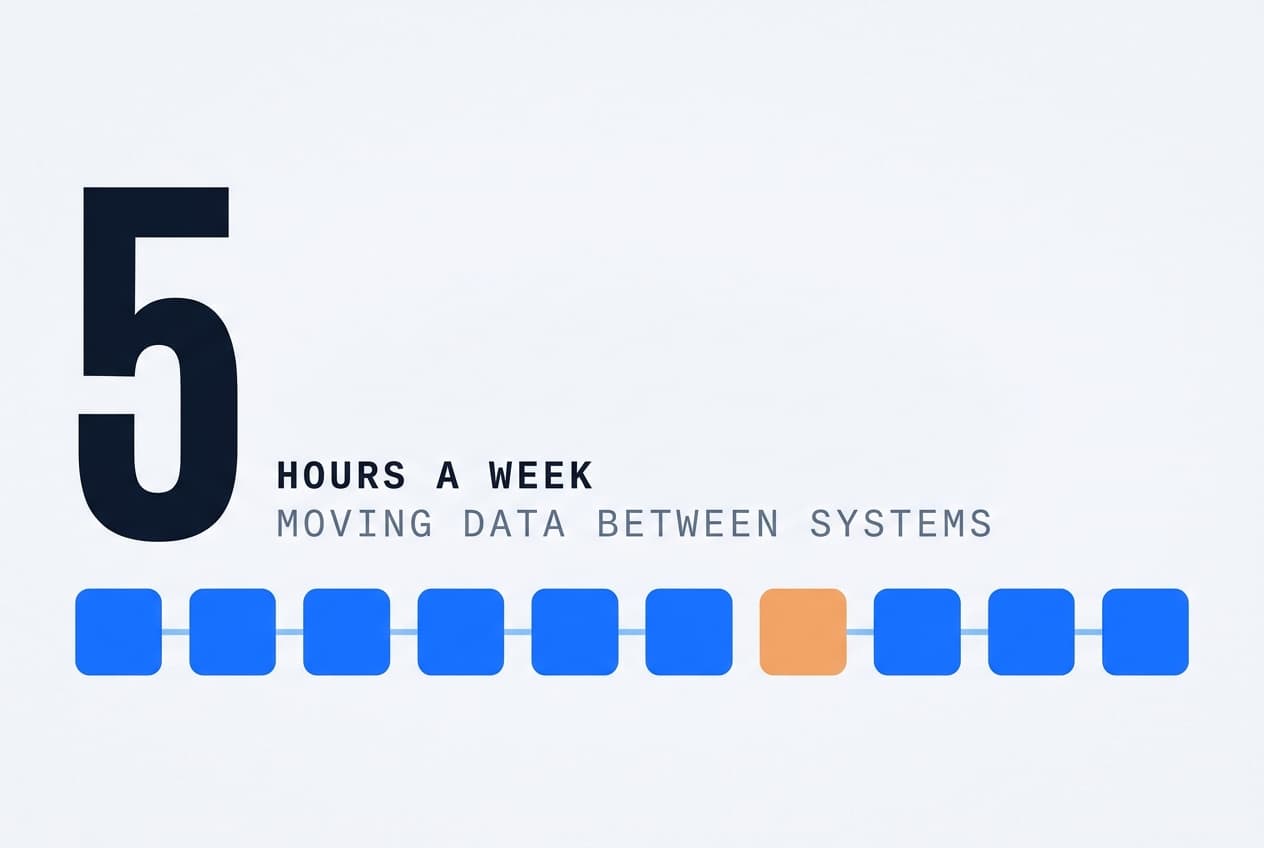
The consequence is measured: an average of five hours per week per professional lost to moving, re-entering or reconciling data across disconnected systems.
Five hours is most of a working day. Over a year it is roughly six working weeks, spent not on accounting but on carrying information from one system to another because nothing does it automatically.
Every Tool Was Bought to Save Time
None of those ten tools was a mistake at the moment of purchase. Each one solved something. The practice management tool solved scheduling. The document tool solved storage. The workflow tool solved handoffs.
What nobody bought was the connective tissue, because no vendor sells it and no single tool creates the problem. The cost appears in the gaps, and gaps do not show up on any invoice. A firm can review its software spend line by line, find every item justified, and still be losing five hours a week to the spaces between them.
This is also why adding an eleventh tool to fix the problem tends to make it worse. The new tool has its own login, its own data model and its own place where things live, and now there are eleven gaps instead of ten.
Why Advisory Is the Thing That Gets Cut
Compliance work has deadlines. Advisory work has intentions.
When five hours a week disappear into data movement, they come out of the only part of the week with no filing date attached. The client conversation that would have been worth having gets postponed to a quieter month that does not arrive.
The survey suggests firms know this: 86% expect AI to increase their advisory capacity within twelve months, and 38% describe it as a genuine unlock. But 54% currently use AI situationally rather than as a default, and 77% agree the gap is widening between firms that have embedded it and firms that reach for it occasionally.
Situational use is what happens when a tool is available but not connected to how the work actually flows. It helps on the day someone remembers to open it.
Fewer Places for Answers to Hide
The useful move is not another tool with another silo. It is reducing the number of places an answer can be.
MetaWurks ingests the documents a practice already has, across PDFs, spreadsheets and scanned files, and makes the whole set answerable in plain English. Retrieval runs across the knowledge base rather than one folder at a time, so the question is what a client agreed to in a particular engagement, not which system that agreement was filed in. A multi-model router selects the model per query, so nobody on staff is choosing between AI tools.
On the data question, the controls are the point, and the survey shows why: 60% of these professionals report clients asking for proof of AI data protection. End-to-end encryption, single sign-on, role-based access matched to engagements, and audit logs recording what was asked and by whom. Documents ingested into the platform are not used to train models or exposed to other users, which is the difference between this and pasting a client's file into a consumer chat tool.
None of that eliminates the ten tools. It removes the reason to open six of them to answer one question.
Join the Conversation
If you added up the time your team spends moving information between systems rather than acting on it, would the number surprise you or just confirm what you already suspect?